Mapping out Dark Code
This is a 30 minute talk I gave at the very first OpenAI Codex Meetup in Amsterdam on March 5th 2026. I introduced the concept of Dark Code.
It was a lot of fun and the audience seemed to like it. My CMO gave me a 7-8 out of 10.
This is not an exact representation of the talk, I improvised, went off-script and forgot things. Also the organizers told me to say the f-word less (4 is bad, 1 would be OK), so in this transcript I've redacted it. At least if you say the f-word, you're quite sure it's not AI-slop ;)

Hi, I'm Jouke and today I'm going to talk to you about Mapping out Dark Code. This is the very first Codex meetup here in Amsterdam, this is the very first presentation of the evening and it's also a first time we're showing Comper to a real-world audience. Lots of firsts. We're happy to be here!

So a bit about me, not to brag, but so you have something to related to. "Affordances" is what they call this in design language.
I'm now 38 years old. [Someone in the audience: I can relate to that]
I started at Mendix as an engineer, then became CTO here in Amsterdam for a tiny startup in online eye testing. Then I left to become a Fractional CTO for 3 years. Now I'm co-founder of Comper. If you follow the sequence, I'll be doing this for just one year ;)
Today I want to talk about how I think the world will change when intelligence is for rent. Then talk about Dark Code, a new concept that I came up with. It logically follows from the Dark Software Factory, so it's not super inventive, but I do like it a lot. Then the assignment for today was to show you what we built with Codex, so I'll give a quick demo of our product.
Then the last thing why I'm here today is that I'm actually scared. The future is more unpredictable than ever. I've just started a software company. I'm very good at software, a skill that is now being commoditized. Most of my friends are in software or other white collar professions.


Humans were the only things that could harvest food or move things around.
Then later, we got horses, oxen and mules for a lot of muscle work. They used horses to move things around because they were better than humans. This is the next level of muscle power, and the human is now the driver. I now want to talk about this guy.


Melanie, our CMO just deployed our new website. Never touched code before. I gave her Cursor and she just did it with minimal help. Is everyone now becoming a developer?


Then the last thing why I'm here today is that I'm actually scared. The future is more unpredictable than ever. I've just started a software company. I'm very good at software, a skill that is now being commoditized. Most of my friends are in software or other white collar professions.
Let me give you a mini 10 second demo of my product, we're mapping all software in your team and allow you to zoom in, and have smart overlays etc. It helps you to rapidly understand a complex software landscape.

We started in October and now have 7 people. Did a pre-seed in January and are hiring. And it's very cool, but it's also Scary to be responsible for a software company in these times.
[dramatic pause with an empty slide for effect]
So why am I scared? Well, let me tell you a bit of a story about something that also changed the world.

Back in the day, human muscles were worth a lot. These farmers harvesting the crops did useful work. Hard work, but if you look at the guy on the right it's clearly work hard / play hard.
Humans were the only things that could harvest food or move things around.
Imagine that you're this person. He's clearly very good at his job. The coat even matches the carriage!
This, dear audience, is someone who knows their shit. They know how hard the horses can be driven, knows when to grease the wheels, which roads to avoid because of traffic, all of that. There were 100's of thousands of these people in the 18th century.
And you know what's funny. I couldn't even tell you now what this profession is called. A horse rider? A carriage driver? Whatever. It's obsolete. But people were so proud to be doing this job.
Now let's talk about the horse.

First a question. How many HP does one horse have? [many in the audience: one!]


Well actually, no. It's 14.9. [confusion all around]
You see, a typical horse can output 14.9 horse power at max intensity. HOWEVER, over the average of a day, you can get one horse power from one horse. So if you said one, you are still right.
It's actually a genius term, horse power. When James Watt invented the steam engine, he needed to sell a bulky, ugly, expensive machine to people. How did he do that? He said: this machine replaces X horses. People loved replacing horses because they needed care, food and pooped everywhere.
Think about that. Watt invented a new unit of measurement, not to deeper understand physics, but to sell his product. Literally "this replaces N horses". Genius.

In our history of muscles, we started with humans, then horses (etc) and only much later, together with the steam engine we got Horse Power.

Ok first of all, this is not pee. It's gasoline. We're now years further, and this is the muscle in the ultimate condensed form. Gasoline. It replaced all the horses. It's energy productized to the max.

But if you look behind the scenes, this product is part of HUGE global infrastructure that is needed to create that simple product, like this dirty refinery.
Humans were proud of our muscles, and industry took it away.

We were also very proud of our intelligence. I was very proud to get a very very high report card at the end of primary school, but my parents didn't care too much. Child trauma. Anyway.

Intelligence used to be, until VERY recently, exclusively human.
And yes I know, LLMs are not truly intelligent.

Purists will say, it's not AGI and definitely not ASI etc.

But, to me this is a bit like saying this back in 2007 when the iPhone came about. "It can do video calling". "Ok but if you look at inter-human communication this is actually only the first step, we'll get VR and brain-to-brain in the future". Sure, you may be right, but right now I have this smartphone, it's awesome and I just want to build cool things with it!
So while we don't have AGI, it's clear that LLMs are some type of intelligent, it's just a bit unclear how much.

I truly believe that we now have intelligence, priced per token. But how much? We don't have a unit for it yet. We have IQ, and SWE Bench, but how much brain time or humans can it replace?

However, I am starting to get a gut feeling for it. For some tasks in my codebase I'm like "Composer can handle this fine, it's super fast, let's go". And for others I'm like: let's see if Opus 4.6 can figure it out.

So what is happening in the world right now is that we're taking something that we took something that was exclusively human, into a product. (Again, not pee.)

And let's not forget, ultimately the companies that build these gigantic data centers are just trying to push more of that product to us. Interesting side note: I'm curious if we are currently demand or supply-constrained.
So let's see where that brings us.

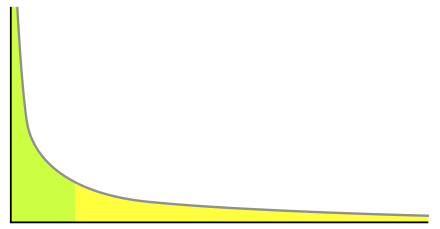
Have you seen this graph? It was popular on Hacker News a couple of months ago. There were also about 25 million horses in the USA before the car came along. If you haven't read this blog post "Horses" by Andy Jones, look it up, it's really great. It's about when something is good enough to replace something else. Spoiler alert: the horses lost to the car and got slaughtered.

I started with "I'm scared". And just like horses, there are about 40 million software developers in the world right now. Some say 20 million full time professional, and a lot do it part-time or for hobbies so 40 million seems right. So where will this "let's replace human intelligence with LLMs" take us? I don't think we'll get slaughtered, but something has to change.
Melanie, our CMO just deployed our new website. Never touched code before. I gave her Cursor and she just did it with minimal help. Is everyone now becoming a developer?

So another post that was popular recently was this one. About five levels of Agentic development. He says 5 levels, but whether you start at 0 or 1, the count is still 6 so that is weird. It goes from Spicy Autocomplete to Junior Developer, to Developer, to Engineering Team to Dark Software Factory.
Just a show of hands, where are you at professionally?
[most said 3, some said 4, other said 5. I think I should have added "At 5 you are spending 1k on tokens per day per engineer".]
Just a show of hands, where are you at professionally?
[most said 3, some said 4, other said 5. I think I should have added "At 5 you are spending 1k on tokens per day per engineer".]
So Dark Software Factories produce something. I'm calling it Dark Code.

The definition is that it's code that no human has written, read or reviewed. So it's dark like, there are no lights.
Now I have thoughts and feelings about this. I think code is not the right abstraction. In Low-Code we put abstractions in place for forms, database entities etc. It was beautiful. Our IDE could reason and check high-level concepts. Agents nowadays just focus on adding code in languages that don't have these abstractions. Good luck on creating a new elegant language now. LLMs are not trained on it and people are not going to write it themselves anymore. In a way, we are cementing our current state of software language development.
Also, I'm often proud of my architecture, code hierarchy or highly performant code. I CARE about some of my code. And now it's just a prompt "Make it faster" and no one cares? My mastery feels hurt.
Also, I'm often proud of my architecture, code hierarchy or highly performant code. I CARE about some of my code. And now it's just a prompt "Make it faster" and no one cares? My mastery feels hurt.

But the good news for me, is that there already is a lot of Dark Code out there in huge organizations. Sure, someone once wrote it, but that person has long since left. So now no one knows how this works.
In fact, that's how my startup Comper got off the ground.

Does anyone know this game? It's called GeoGuessr and we were playing it in my office a lot when I was CTO. [a lot of people said yes!]
You see a place in google streetview and you have to guess where you are, it's super fun.
Someone from marketing saw us playing this and said "why don't you create that for code?". I thought it was brilliant. You see some code that you or someone in your team once wrote and you have to guess where it is. I started building the game, and figured out how to make a map out of all the software code in the company. Then I figured out it was useful for a lot of other things.
Now, one thing we had was the bus factor: an area is in bad shape if all the authors have left. Because then no one knows about the code anymore. Both the game and the bus factor don't really matter anymore in a world where everything is Dark Code....
That was my last point. Now I'll give you a quick demo, because that was the original assignment for tonight.
[ here I gave a 5 minute demo of Comper, including the game ]

Alright, thanks a lot. Questions? [there were questions but I forgot the details].


Comments
Post a Comment